
Jurassic Oceans review, Natural History Museum
Are you brave enough to come face to face with the terrifying monsters of the deep which lived beneath the waves while dinosaurs roamed the earth? That’s the challenge from Jurassic Oceans, the new exhibition at London’s Natural History Museum.

review visit*
Spoiler alert – this is easily one of my favourite exhibitions I’ve visited here over recent years, cleverly targeted to appeal to younger kids, older kids who want more depth, and adults, with some eye-catching displays, videos, interactive elements and a few unexpected surprises.
And as my Jurassic Oceans review goes to show, there’s plenty to get you thinking about evolution and climate change, as well as child-friendly winners like holding Jurassic poo and a trail to decide which creature deserves to be crowned the most ferocious predator in the sea.
Stepping from the sunshine into the shadowy blue world of the Jurassic Oceans exhibition, you’re quickly transported back in time around 200 million years to the Jurassic period.

First, the exhibition sets the scene of what life was like at the time; the world was a hotter, more humid place, with tropical storms and volcanoes, and warmer, more turbulent seas which covered much of the earth.
While pterosaurs flew overhead and dinosaurs stalked on land, the single landmass of Pangaea was breaking apart and opening up new marine corridors for life to thrive in. It’s the age of reptiles on land, in the air and in the seas as well, with ferocious predators ruling the oceans, which are teeming with life from the tiniest plankton to long-necked plesiosaurs.
Get a look at the whole Jurassic Oceans exhibition in my video


And the exhibition quickly whisks you from land, via dinosaur footprints and the decline of earth’s giant amphibians to introduce you to the underwater world, including early marine reptiles like the thalattosaur, but also everything from the bottom of the food chain to the top, including Jurassic corals, huge sea lilies and ammonites (the ancient relative of octopuses, squid and nautiluses).
Throughout, you’ll find information linking these extinct creatures and ancient marine world to the present – one type of extinct squid would use ink as a defence, just as they do today, but unlike reptiles, which have shrunk over the ages, the colossal squid is believed to be the biggest squid alive today, far larger than any of its Jurassic ancestors.

Or did you know that horseshoe crabs look much like their ancestors did hundreds of millions of years ago, surviving every mass extinction the planet has endured so far.
There are lots of other clever touches to make it appealing to different ages; more complicated words are spelled out phonetically for younger visitors, but there’s plenty to get older visitors thinking, including a reminder that while life on earth adapted to changing conditions millions of years ago, climate change means that today’s warming planet is heating faster than life can evolve.
You’ll also find ‘dive deeper’ sections on many of the boards, giving more background – such as one on Mary Anning, who discovered the first complete plesiosaur skeleton among other fossil finds, or another explaining how shells help us tell what sea temperatures were like so long ago.


Along the way, kids can also stamp their trail sheet and decide which creature they think has the fierce factor – each board has a suggested rating if you’re not sure just how ferocious they really were.
Plus all ages can get hands on, from touching an ichthyosaur skull to an ammonite fossil, dinosaur claw and 70-million-year-old mosasaur tooth, along with some interactive screens including quizzes towards the end of the exhibition and the chance to compare your hand to a long-necked plesiosaur’s flipper.


But it’s the monsters of the deep which are the big draw – and if you have kids who are afraid of sharks, it’s worth knowing there’s an entire section devoted to them, including the huge megalodon, (three times the length of a modern great white, with a jaw that could open 2.5 metres wide), as well as gentle giants leedsichthys, similar to today’s basking sharks, and smaller Jurassic sharks, hybodus.


Even more ferocious are the bigger marine reptiles for whom these sharks made a tasty snack – such as the ichthyosaur, the long-necked plesiosaur, the mosasaur (aka the T-Rex of the sea, a slightly later inhabitant during the Cretaceous period) and the giant liopleurodon, which could eat pretty much anything it came across and swallowed its prey whole .
After watching video recreating an underwater attack, I suspect I won’t be the only person jumping at the sudden flicker of light across the floor or the unexpected roar from an information board.


This section is definitely the highlight of the exhibition, with skeletons, models, fossils and facts, even the model of an ichthyosaur brain moulded from the fossil of a skull, which has been compared to modern reptile and whale brains, showing these creatures would have been fast, with good eyesight and smell.
Other fossils have shown the ichthyosaurs would have lived – and hunted – together as a group too, while they would have been well camouflaged in the water.


And the exhibition does a great job of bringing home to visitors just how impressive a predator these marine reptiles would have been, from their speed in the water to their ability to sniff out prey, their size, and everything from hinged jaws to swallow prey in one mouthful to viciously sharp ridged teeth.
There are even bones showing the damage done by these predators, long-preserved evidence of just what those teeth could do.
In the low blue lighting, it’s not hard to believe you’re beneath the waves as you look at the skeletons, stroke scales and thank your lucky stars that none of them are about to open an eye and pounce.


By comparison, today’s ocean predators – the subject of the final section of the exhibition – are just as vital to their own marine environment but even the ambush attacks of a saltwater crocodile feel less terrifying than these Jurassic monsters. (Although obviously, I’m always happy to give any crocodile a very wide berth).
Jurassic Oceans exhibition: Need to know
The Jurassic Oceans: Monsters of the Deep exhibition opens at the Natural History Museum on Friday May 22 and runs to January 3, 2027.

Tickets cost from £15 for adults and £7.50 for children aged 4-17 off-peak. Kid aged three and under go free. Includes museum entry, so you don’t need a separate prebooked ticket.
It’s open from 10am to 4.30pm each day with time slots every 15 minutes, and you can expect to spend around 40 minutes to one hour in the exhibition.
There are also relaxed viewing sessions from 10–11am on the first Wednesday and Saturday of every month.
The gift shop at the end includes some great books, including Dinosaur Lady on Mary Anning, and Everything You Know about Sharks is Wrong (in case you need to give them some good publicity after seeing the megaladon), as well as an impressive variety of cuddly marine creatures.

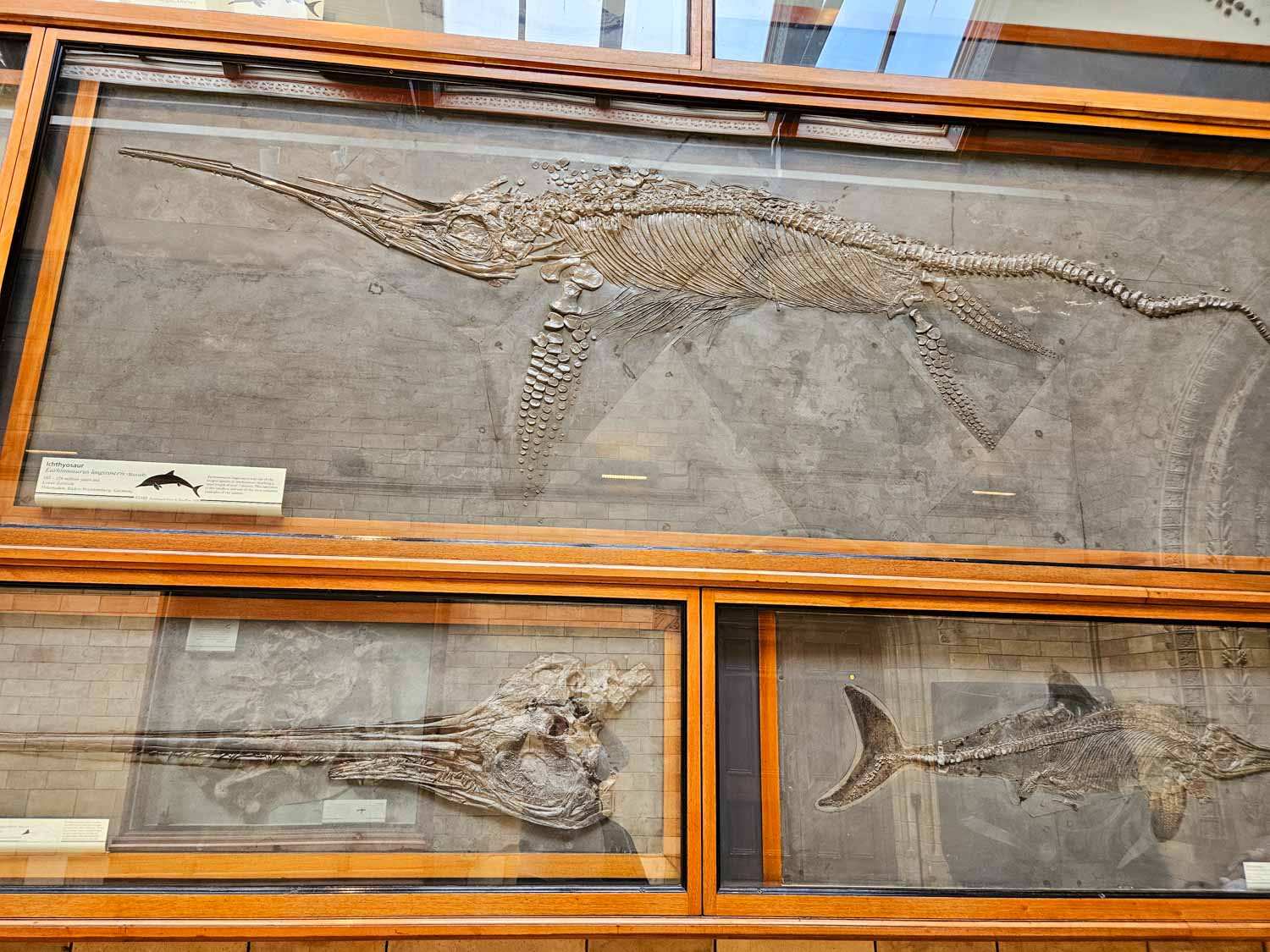

As you leave, keep an eye out for some other marine reptile fossils, including an ichthyosaur, and more on Mary Anning, just as a bonus.
Disclosure: I was given free entry ahead of public opening in order to write this review – all opinions remain my own.
Images copyright MummyTravels
LIKED THIS? SIGN UP FOR MY EMAIL NEWSLETTER