Aruba tips: need to know before your Caribbean holiday
It’s easy to consider the Caribbean’s islands as all very much the same – palm-fringed white sand slices of paradise. Which is true in some ways… but as we visit more of them, it’s the differences which stand out – so I’ve compiled my Aruba tips if that island is next on your list.

contains affiliate links*
And frankly Aruba should be on anyone’s list of family holidays to the Caribbean: sea so turquoise it’s gleaming, geckos just as brilliantly blue, calm water for snorkelling and desert interior to explore, plus rock formations, ancient caves, donkeys, ostriches and butterflies to discover away from the coast.
So here’s what you need to know before you visit Aruba with kids, with my 17 top Aruba tips…
You can fly direct
There are direct flights from the UK to Aruba with TUI for part of the year, and the flight is around nine to nine and a half hours.
Otherwise, you can travel via Amsterdam with KLM – Aruba is a self-governing part of the Kingdom of the Netherlands – to avoid going through US immigraton. If you are flying from the US, there are direct flights galore.
There will be some jetlag
Aruba is on Atlantic Standard Time which is four hours behind GMT or five hours behind British Summer Time – it’s also the same as Eastern Daylight Saving Time if you’re coming from the US east coast.
You don’t need a visa
If you’re an EU, American or Canadian citizen, you don’t need a visa to visit – for now, that also applies if you’re a UK passport holder (and hopefully will continue to do so after Brexit…).
Bring your dollars
US dollars are very widely accepted – you might get florins back as change (the Aruban currency). Sadly we didn’t as some of the coins are square which would have been rather cool to collect.
In fact I used my credit card most of the time.
You don’t need any special vaccinations
There are no immunisations recommended beyond the usual ones you’d have for day-to-day life in the UK – and there’s also no malaria in Aruba.
There is a risk of Zika though, although it has dropped, but do bring mosquito repellent – pregnant women are most at risk if they are bitten by an infected mosquito.
Having said that, we never heard so much as a whine from a mozzie – the sea breeze seemed to blow most insects away, and after the first night, I don’t think I even applied any repellent…
Don’t worry about hurricanes
Aruba is – happily – south of the hurricane belt so hurricanes are very rare, and when they do touch the island at all, they tend not to cause major damage (the last was back in 2007).
As above, there is usually a good breeze so it’s perfect if you fancy windsurfing – if you fancy playing cards by the beach, bring something to weight them down though!
The sun is still very hot, so don’t think you can skip the sunscreen – expect temperatures from around 25C to the low 30s year-round.

Bring reef-safe sunscreen
Aruba banned any sunscreens containing oxybenzone on the island 2020 – you can easily buy reef-safe products at Aruba Aloe.
And don’t expect much plastic
The island has announced a total ban on all single-use plastic, starting in 2019 with a transition to a total ban in 2020.
We saw no plastic straws and while there are still plastic cups around, they’re not as common as elsewhere – even on boat trips, we were reminded to make sure empty ones went into the bin in case they blew overboard, and asked to pick up any plastic we found when we went snorkelling. Happily the seas were clear.
Do drink the water
All tap water in Aruba is safe to drink – the island has the third biggest desalination plant in the world, so all the tap water in hotels and restaurants is fine. Makes life easy AND cuts down on plastic.
Even fussy eaters are happy
There are plenty of choices for food, whether you’re looking for international options including pizza (Casa Tua in Palm Beach is easily the best) or US chains or plenty of ultra-fresh fish. Tuna tataki at Hadicurari on Palm Beach was delicious.
You can find Caribbean favourites as well – I managed to get my fix of conch fritters and Johnny Cakes at the fabulous seafront restaurant The West Deck near capital Oranjestad.
We were told that Arubans love their fried food – plus you often get US sized portions so you definitely won’t go hungry. In fact, beware of over-ordering 😉 But you’ll also find plenty of vegan food, for example.
Either way, there was enough choice for even fussy kids (like my daughter) to find something they liked, often with separate children’s menus, plus plenty to keep adults happy too.

It’s less Dutch than I expected
Although you’ll find Dutch influences around the island, and Dutch is one of the two national languages – along with Papiamento, a musical mix which has influences from a whole string of languages and dialects – this isn’t a mini Holland.
Go to one of the French Caribbean islands and it could be a more tropical version of Nice. Here, there are far more international influences.
Around 20 miles from the coast of Venezuela, Spanish is widely spoken, and with US tourists galore, English is also spoken island wide.
Bring a US adapter
Plugs are 120 volts and coming from the UK, it’s the US plug adapter that you need.
You’re not short of US chains either
Palm Beach is the most touristy and built up part of Aruba – most hotels are around Noord, including Eagle Beach, but Palm Beach is the high-rise zone.
That includes the Hilton, Hyatt, Marriott, Holiday Inn plus the Ritz Carlton.
There are also two big RIU hotels on that stretch – the adults-only Riu Palace Antillas and Riu Palace Aruba – as well as a Barcelo hotel.
But you can find independent hotels as well, along with villas, and you needn’t go too far to find quieter spots.
Or US brands
If you head to the supermarkets, you’ll find a lot of US brands which get shipped in.
If you don’t have a car, you’ll need to take a taxi to reach them but as prices can be high in the tourist locations, especially with mark-ups, it can save you money to do that.
Quirky trivia fact: the supermarkets are mostly owned by Chinese immigrants to the island, going back generations.
It’s happily casual
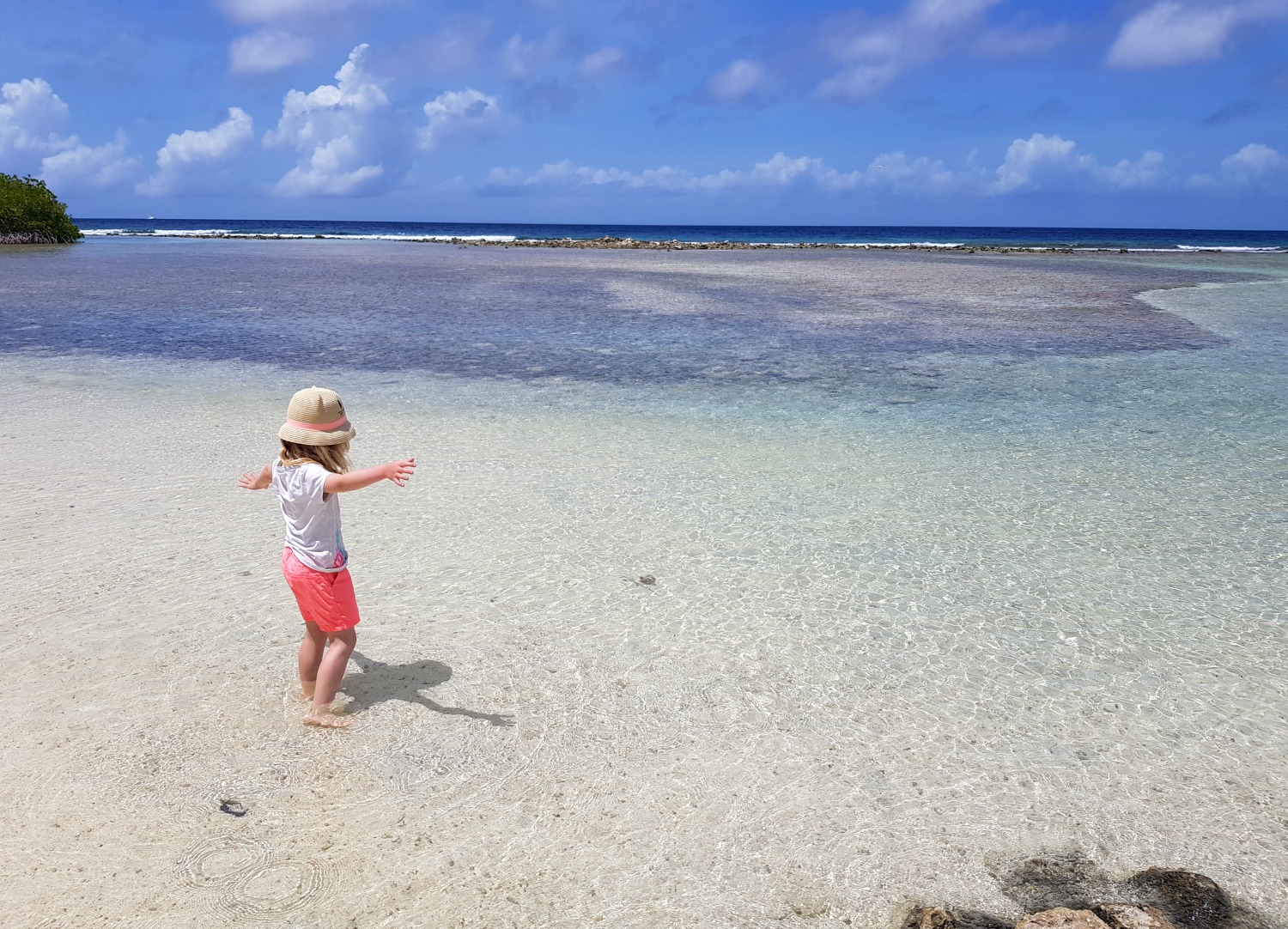
You’ll find occasional signs requesting no wet swimwear, and the odd restaurant to dress up for, but otherwise Aruba is pretty relaxed when it comes to what you wear.
Between beach and pools, you’ll spent half your time in swimming costume or bikini anyway (even on our off-road tour of the island I had my swimwear on underneath as we were finishing at Baby Beach).
And the water is great for kids
Although the north coast has bigger waves crashing against its coast and beaches, the gloriously clear water of the south coast is often as calm as a bath (and about the same temperature).
It’s ideal for snorkelling, especially for kids to try for the first time, or for littler ones to paddle and splash.
It’s one happy island
Aruba calls itself One Happy Island – and that particular nickname fits perfectly. You’ll spot it all over the island as you explore.
Or for a couple of other phrases in Papiamento to memorise, ‘bon bini’ means welcome while ‘biba dushi’ means living a sweet life. Sounds pretty good to me!
PIN FOR LATER: ARUBA TIPS – NEED TO KNOW BEFORE VISITING ARUBA

Piggy bank image courtesy Depositphotos, all others copyright MummyTravels
LIKED THIS? SIGN UP FOR MY EMAIL NEWSLETTER
It looks and sounds like a wonderful place to visit. I must admit that I had never thought of visiting Aruba before reading this x
It’s such a beautiful island – I admit it was a slight spur of the moment decision when I found the cheap flights, and we definitely came across more Americans than Brits there, but it’s a gorgeous place. Lots more to share! 🙂