
A long weekend in Herefordshire with kids
Where in England can you find a map packed with fantastic beasts, a manor house with links to three kings (and a ghost), the site where a Queen’s husband was executed, and ponds which date back to the Ice Age – yes, the biggest surprise when exploring Herefordshire with kids is that we hadn’t visited before.
ad/review stay – affiliate links*
In fact, it amazes me slightly that during decades travelling in the UK, I’ve barely set foot in Herefordshire: we’ve visited the Forest of Dean to the south, Shropshire to the north, and ventured across the border into Wales. But from the cathedral city of Hereford to the Wye Valley and countryside, our long weekend felt like discovering somewhere entirely new.
And the best things? Firstly, the county is relatively small so you can pack a lot in during a short break or weekend in Herefordshire with kids. It’s also a great place to escape some of the crowds, plus there’s a huge amount for families.
So if you want a little taste of some of the best things to do in Herefordshire for families, here’s how we filled three days – plus some added tips on more family-friendly things to do.
Contents - click to jump to a section
Day 1 – Ice Age ponds
Herefordshire’s countryside is gorgeous – gentle rolling hills with the Black Mountains in the distance, the bright yellow of rapeseed and pink blossom in spring, huge old trees and a climate which means you get an impressive range of flowers.

But if I’m happy to drink in the views and revel in the loveliness of the English countryside, my daughter needs a bit more motivation.
Which is where the new Ice Age Ponds trail app from Herefordshire Wildlife Trust came in handy.
There are 12 trails to choose from (including some by car if you want to venture further afield, others which you can do on a bike) and they’re packed with information about everything from the wildlife and plants you’ll find to the geology.


Because while the rolling hills are gentle enough for my daughter to sprint happily up and down, they were carved out long ago by glaciers, huge ice sheets that rolled in from Wales – although in geological terms, it’s not that long ago, with the Ice Age ponds created along the way surviving for 12,000 years.
We headed out on the 90-minute Birches Farm Trail, spying red kites circling over head, warblers warbling in the trees and wildflowers galore, as well as orchids beginning to grow in the grass alongside the cowslips.


It’s an easy wander, so it’s a great option with younger kids too, and there are a few AR bonuses planned, such as having a photo with a virtual mammoth (having tried something similar in Norfolk, that was a huge hit).
Without the app, I know we’d have missed a lot of the detail and understanding of what we were looking at – in fact, we’d probably not have realised we could even walk here. With the sun shining on us, it was the perfect start to the weekend.
There are various other suggested Herefordshire walks to try as well – the Roasts and Rambles guide features ten circular walks with pubs along the way, or if you visit in spring, the spring guide showcases some of the best blossom spots
Day 1 – Hereford
I’d expected history galore when we explored Hereford, but what I hadn’t realised beforehand was just how great it is for foodies.
And as we’d worked up an appetite walking through the countryside that morning, we’d earned our lunch at The Yard before exploring the cathedral and historic streets.


Iit’s a lovely spot to while away a few hours over some food – there are tables dotted around in the courtyard (with heaters!) and you can order from several different restaurants plus a bar to your table.
So if you’re wondering where to eat in Herefordshire with kids, this is ideal – there was a great kids’ burger for my daughter, but I had the choice of Indian food from the grill, some great brunch options like smashed avocado, tapas style dishes including lamb croquetas… even if I eventually went for a truffle burger myself.
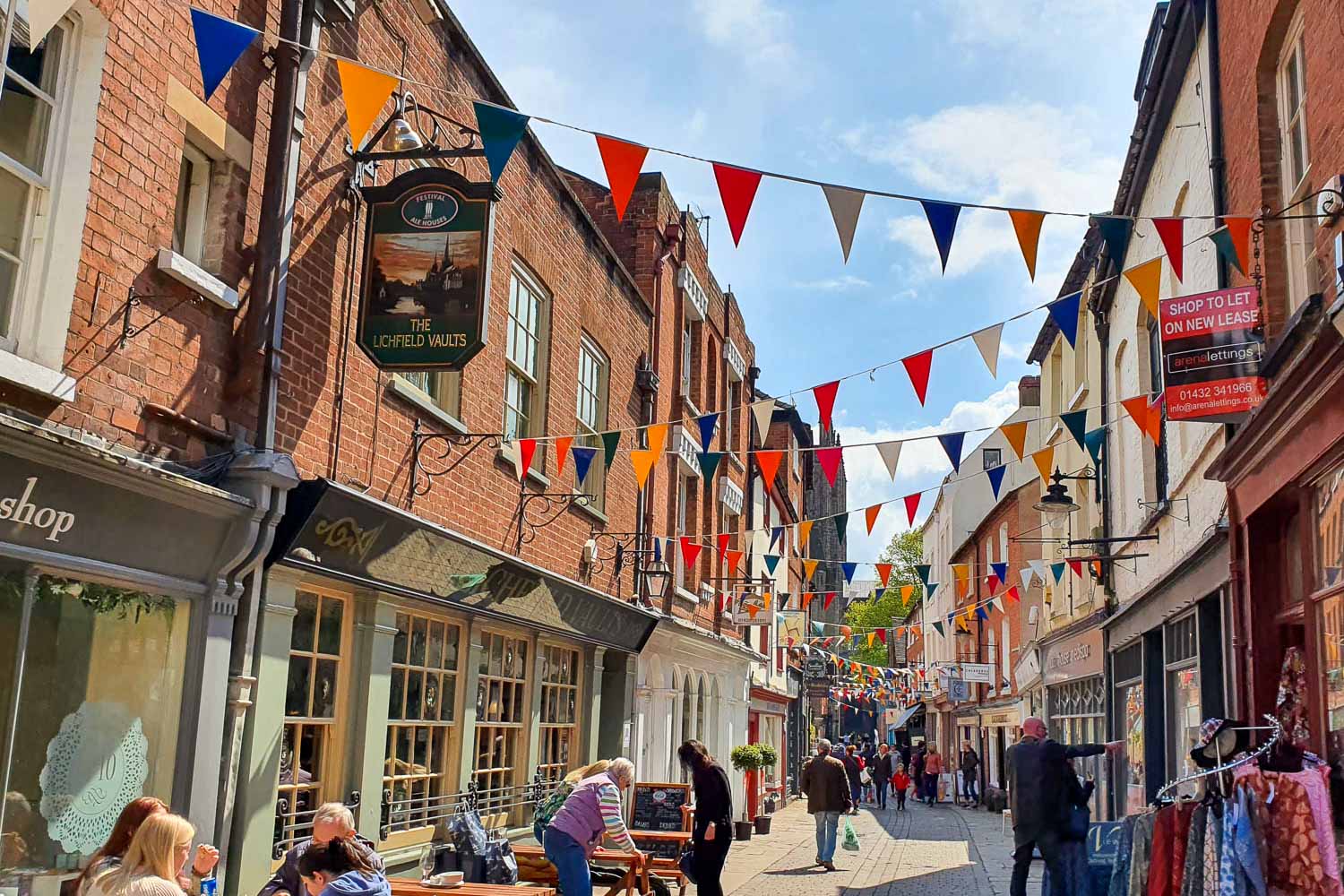
As you wander around the city, don’t miss a walk along Church Street, which is packed with the kind of little shops you want to browse endlessly, including cafes, delis and a fabulous cheese shop called the Mouse Trap.


Not far away is the market too, where the stalls had everything from dried fruit and olives to ice creams – look between them and on the pavement, there’s a plaque commemorating Owen Tudor, husband of Henry V’s widow Queen Katherine, executed here back in 1460.


Or grab some provisions at the Buttermarket, where you can find fantastic doughnuts behind the half-timbered facade, one of a string of black and white houses in Hereford that includes the Jacobean Black and White House Museum in the marketplace, the last one of a row left standing.
Hereford Cathedral with kids
One of the biggest highlights of our day in Hereford was exploring the cathedral – and if you think that doesn’t sound child-friendly, there are more than a few sights which make it unmissable, including the Chained Library and Mappa Mundi.


The cathedral itself is wonderful: dating back almost 800 years, it’s worth wandering around the outside before you head in, to see the imposing front door (the entrance is currently to the side) and the stone, which looks almost pinkish in the sunlight.
Once inside, we were told to look out for the tomb with pigs on – definitely not something we’d ever come across in a cathedral before – but barely got through the nave before we found some more intriguing sights.


There’s the tomb of the three-legged knight. Not an actual three-legged man, but where the effigy’s legs have been replaced and repaired over the years until he’s left with three – two resting on a lion (probably, it was a bit tricky to see its face with part of the nave roped off), the other propped up against a pillar.


There’s also a tiled labyrinth on the floor, which Minnie proceeded to pace around several times, and a brightly coloured shrine of St Thomas Cantilupe, one of the cathedral’s two saints – the other is Ethelbert, king of the Angles, murdered in the 8th century by Offa of Mercia (the one with the dyke).
And around the corner, the pigs! A play on the name of the bishop buried there, a man named Swinfield, his own feet are resting on a hog as well.


But as an avid Harry Potter fan, my daughter was keen to get to the Chained Library, which sounds like it’s straight out of the restricted section at Hogwarts.
Set within a new building, the books themselves are older than the cathedral – one dates back as far as the 8th century, and even the locks and chains attaching the books to the shelves are the original 17th century metal.


At the time, this new system was the latest in library innovations, designed to keep the medieval books safe and secure – which is also why they face with their spine in – and they’re still consulted by researchers today.
The medieval Mappa Mundi meanwhile, was created around 1300 – a sort of pictorial encyclopaedia which mixes geography, myth and a generous helping of legend.
At first glance, it’s a map of the known world, except in this version, it’s centered around Jerusalem – the British Isles are definitely a bit of an unexpected shape and Scotland seems to have floated off entirely, although you can make out Hereford.


And while you’ll find lots of specifics, right down to the labyrinth at Knossos on Crete, there’s a lot of generous licence about just how close some countries are to each other.
But what’s even more fascinating is the way that fantasy is mixed in with fact: next to Crete, you’ll find Scylla and Charybdis from Greek myth, drawn as if they were just as real as the island.
Elsewhere you can see a basilisk (unexpectedly cuddly), a mandrake, manticore and minotaur, which opened my daughter’s eyes to the fact that these fantastic beasts have been around a lot longer than the Wizarding World.


There are a few ambitious attempts to depict real life creatures, which the creators of the map would never have seen – a rhino that’s distinctly skinny to modern eyes, and a fabulous swordfish, which has its sword neatly sheathed along the side of its body by its fins. Sometimes truth is stranger than fiction.
Although not as strange as the inhabitants of the map’s unknown worlds: Africa, which would have been something of a mystery to the artists, is peopled by distinctly unexpected humans, including people with huge lips to shade their heads or eyes in their chests for example.
I could have pored over it for hours: it’s absolutely mesmerising.
Entrance to the cathedral is free but there’s a charge to visit the Chained Library and Mappa Mundi.
Day 2 – Hellens Manor House
It never ceases to amaze me just how much history you can find in one small spot in England. The beautiful manor house of Hellens would be worth a visit regardless, with its lovely old rooms and gorgeous grounds – but discovering some of its secrets from through the centuries was easily the best part.

Once part of King Harold Godwinsson’s lands – although it’s hard to say if he ever visited before the Conquest – the manor was later a safe haven for Roger Mortimer after he and Queen Isabella deposed Edward II, and here that Edward III was given the royal seal.

There are later links to the Boleyn family as well – the offspring of Mary Boleyn and (almost certainly) Henry VIII, with some of Anne Boleyn’s own possessions to be seen in family portraits and on display.


For more Tudor links, there was even a room decorated for Mary I, who was due to stay there – it has since been restored, with her emblems on the furnishings, but you can also see some of the original decoration and a reliquary on the mantelpiece.
Look up to the ceiling for a decorative pomegranate… although like the medieval makers of the Mappa Mundi trying to depict a rhino, the craftsmen behind this had almost certainly never actually seen one. They had a good try though.

But while the records go into detail about the work to prepare for the Queen’s visit, there are no documents talking about her ever arriving in the end. Although there is a record of the owner going bankrupt, possibly as a result of all the lavish renovations.
As a final twist, the room is also said to be haunted by a 17th century priest who fell foul of the Roundheads, caught on his way to a priest hole, with his ghost heard by people who’ve slept here.


Elsewhere, a daughter of the house who eloped with a stablehand, spent 30 years locked up in her room on her return – you can still see a message scratched into the glass of her window from her decades in this gilded cage (for punishment or her protection? You decide).
The twist here is that her husband’s initials have been scratched on a different pane – on the outside, suggesting that he came to visit her while she was confined here. The story even helped inspire a 2017 children’s book, Evie’s Ghost.


Elsewhere inside you can see art by everyone from Van Dyck and Goya to Tintoretto, a four-person chess board, a harpsichord, a Swedish crown worn by brides of the family, and portraits galore.
Outside, there’s just as much to discover in the grounds, including a hedge labyrinth, a knot garden, herb garden (look out for the poisons section), wildflower meadow and woodland to explore. Not to mention the ring of standing stones, engraved with poetry.


It’s one of the loveliest places to see spring blossom as well – there’s a cafe here but if you fancy a picnic, stop off at The Nest nearby, a farm shop with some impressive Scotch eggs, a huge array of delicious cakes and plenty more tempting provisions.
Day 2 – Canoeing the River Wye
If you’ve had a taste of countryside, city and some of Herefordshire’s historic houses, the final unmissable thing to do in Herefordshire with kids is head to the River Wye.
You can walk along the banks in Hereford itself, but even more fun is getting out onto the water in a canoe.

There are various different options from Hereford Canoe Hire to explore some of the quietest stretches of the River Wye, cleverly designed so you won’t be paddling against the current (which having done just that in Exeter, I’m happy to avoid!)
You can hire canoes for a full day, but we went for a three-hour jaunt – which gave my arms a good workout, but with two adults paddling, helped intermittently by an enthusiastic daughter, was definitely doable.
Parking our car at a campsite near Hoarwithy, we were taken over to another site at Lucksall, where we were briefed, shown a map and kitted up, including a barrel to keep our bags in (although cleverly I’d forgotten to bring the waterproof case for my phone once again).

You have life-vests to wear, although when we went the river was so low that there was more chance of beaching ourselves than submerging. Having proved we could canoe in a circle, we set off downstream, the current helping us along the way.
And it was incredibly peaceful – apart from birds and the sheep leaping nimbly along the banks, we hardly saw or heard another person.

You can spot kingfishers (although not with chatty small girls testing how loudly their voice carries across an otherwise tranquil river) as well as countless swans and herons, ducks were out with their ducklings and sand martins swooped along the banks.
For some added excitement, there are a few little rapids to speed over along the way – it’s certainly not white water (I stayed entirely dry) but it got us all giggling as we paddled at top speed.
Day 3 – Eastnor Castle
After a weekend of (mostly) glorious early May sunshine, our weather luck ran out at the end of our trip – so combined with the fact that the interiors of Eastnor Castle were closed at the time, meant that we really didn’t get to see it at its best.

Despite the relentless rain, we still managed to spend a couple of hours exploring the grounds and play areas, so this is somewhere you could happily while the day away when the sun shines.
Unlike some of the other historic castles in the area, Eastnor Castle is practically a newcomer, built in the 19th century, although that’s on the site of a previous manor several centuries older.
And it has the kind of sprawling grounds you’d expect from a stately home, with a lakeside and woodland walk, as well as regular family activities, plus the spectacular interiors.


For our visit, it was all focused on the outdoors. The maze was closed but Minnie set straight to work testing out the various playgrounds with a go on the obstacle course.
There’s also an adventure playground, with some fun static vehicles, slides, wooden towers to climb on and some great net tunnels leading to a little treehouse.


And that’s not the end of the chances to play, with natural play areas out in the woods as well – we headed off around the lakeside walk, which has some lovely views back to the castle itself.

And towards the end of the path, past a little stream that was shallow enough to splash in, or with stepping stones as an added bonus (and a dry route round if you didn’t want to risk soggy feet), there are several areas with tree stumps to hop between, logs to balance on and more, plus added adventure for my daughter on the slippery wood.


Although you can easily do a single loop around the lake, there are plenty of paths to wander among the trees, with our route eventually taking us back to the rear of the castle and a quick peek over the walls to the grounds, before ducking through a few tunnels to the courtyard.


With regular family activity days, including everything from animal encounters to birds of prey displays, living history and a steam weekend, there’s usually plenty of extra fun taking place as well.
For more great family days out, check out my pick of the best UK castles with kids
More things to do in Herefordshire with kids
Follow the black and white villages trail
There are quite a few contenders for prettiest places in England, but Herefordshire has an extra ace up its sleeve as well as the gorgeous scenery – its black and white villages.
You can theme a mini road trip around them too, with a 40-mile circular route from Leominster which takes you to around a dozen stops along the way.


Eardisland is supposed to be the prettiest, while we stayed in lovely Eardisley and managed to catch a glimpse of Weobley during our weekend in Herefordshire as well.
You could easily team a few village stops with walking in the countryside, as well as checking out some of the pub gardens in the villages along the way.
Goodrich Castle
One of our few previous visits to Herefordshire, we explored Goodrich Castle while visiting theForest of Dean.
One of the many fortresses built along the border – Marcher country – by the English to guard against the Welsh and later to enforce their rule, it’s partly ruined but there’s still lots to discover, from historic toilets to a dungeon and chapel.

It’s also home to Roaring Meg, the mortar which did most of the damage to the castle during the English Civil War, plenty of family activity trails and fantastic views out to the River Wye and Wales.
Walk with llamas
Another great way to get out and walking is alongside the Golden Valley llamas, at a farm in the foothill of the Herefordshire Black Mountains.
As well as grooming them, you can head out on a three mile stroll with lots of time to admire the views as the llamas stop for a nibble – and it’s child-friendly too, although those aged under 12 have to share a llama with an adult.

Visit Croft Castle
This National Trust site is surrounded by 1,500 acres of parkland, so there’s plenty of chance to get outside at Croft Castle, with a string of walks around the grounds.
The castle’s own history dates back to the 11th century: listed in the Domesday book, it has played a part in the Wars of the Roses, been owned by a Queen’s favourite and lost thanks to unwise investments (before being bought back by the family once again).
See Arthur’s Stone
This Neolithic Burial Chamber is said to have inspired the stone table in CS Lewis’s The Lion, The Witch and the Wardrobe, so it’s perfect for any small fans of Narnia.
As the name suggests, Arthur’s Stone has links to the legendary king too, said to be where he slew a giant – who left the impression of his elbows on one of the stones as he fell.
Free to visit, so it’s easy to stop by and see if you can see them…
Where to stay in Herefordshire with kids
We checked into Arboyne House in Eardisley – one of the villages on the black and white trail, there are two self-contained apartments attached to the 18th century main house.
And Holly Lodge, where we stayed, is perfect with kids – there are three bedrooms, so it can sleep up to six, a proper kitchen for self-catering and you’re in a great location to get around.


It seemed that we rarely had to drive more than about 30 minutes to reach any of the places I’ve mentioned on my list for a long weekend in Herefordshire, plus there’s a four-poster bed, big gardens, a craft studio and some seriously delicious tiffin bites.
Check out my full review of Arboyne House for a stay in Herefordshire with kids
*First published 2021, last updated 2026*
Disclosure: My stay was courtesy of Visit Herefordshire, with entry free from the various attractions – all opinions on the best things to do in Herefordshire with kids are my own. This post contains affiliate links – any purchases you make are unaffected but I may receive a small commission
Images copyright MummyTravels
LIKED THIS? SIGN UP FOR MY EMAIL NEWSLETTER